One night, while trampling the emotions memories of Federico, a chain of decisions leads even point of no return. And when I least expected it, not knowing when your clock showed, his life changed forever ... for eternity. Regardless of the name, neither good nor bad he did, or how others judge them, only their decisions will make the difference when you get ... the Zero Hour.
In a castle, somewhere in the Thirld World, Diaz is delirious, dreaming of the power he had in Eldorado, while oppressing the indians, workers and peasants. He is well aware of the menace his old victims represent, while a miracle-making shepherd fascinates and frightens him. Diaz finds a countrywoman, symbol of purity, and prepares a ceremony in his castle resembling his own funeral.
Relive an unspeakable tragedy detailed with unforgettable images, videos, and recordings only recently rediscovered.
As admired as he was controversial, Sade is a doubly scandalous figure: through his actions and his writings, veritable catalogues of sexual perversions. Imprisoned in the 18th century, vilified, condemned to clandestine publications, "the divine marquis" has become synonymous with a condemned sexual practice: sadism. Sade, however, would be partially rehabilitated, would greatly influence French intellectuals, and would be lauded by the greatest figures: from Baudelaire to Giacometti, from Pasolini to Simone de Beauvoir. Today, some even go so far as to consider Sade a feminist figure. To mark the acquisition of the manuscript of "The 120 Days of Sodom" by the National Library of France, "Le Doc Stupéfiant" offers a unique portrait of a libertine without limits.
Falcino, a small town in the south of Italy. No one sees. No one hears. Nobody talks. But everyone knows. And so they all become accomplices of a tragedy against women, against kids, against a family. A story of violence and slavery. Indifference is stronger than their conscience. Maria, a young mother of a family, lives with her husband Gerardo and her two children, Rocco e Carmela, on her father-in-law's farm: "grandpà" Giuseppe. Gerardo decides to emigrate to Austria to earn more money so as to allow a more comfortable life for the family. This absence will be the beginning of a nightmare that will lead Maria and her daughter to be victims of abuse of an unscrupulous ogre (monster).
Based on the official transcripts of the investigation that followed after the very suspicious notorious death in prison of one of the most important leading men of the South African anti-apartheid movement, Steven Biko.
The political advisor to the French emperor Napoleon, and the Austrian emperor Franz I, arrange a marriage between Napoleon and the Austrian archduchess Marie-Luise in order to prevent another war.
A village in Mazowsze, 1943. Two teenage boys, Janek and Staszek, find two young Jews hiding on a farm. They soon realize that the boys, Abram and Chaim, are their age and are the sons of a respected pharmacist who lived in a nearby town before the war. They were the only survivors of the anti-Jewish pogrom led by the Germans in the nearby forest. In spite of the deadly threat, Janek and Staszek decide to hide the boys and keep it a secret.
Between 1933 and 1945 roughly 1200 films were made in Germany, of which 300 were banned by the Allied forces. Today, around 40 films, called "Vorbehaltsfilme", are locked away from the public with an uncertain future. Should they be re-released, destroyed, or continue to be neglected? Verbotene Filme takes a closer look at some of these forbidden films.
"The End of the Line - Rochester's Subway" tells the little-known story of the rail line that operated in a former section of the Erie Canal from 1927 until its abandonment in 1956. Produced in 1994 by filmmakers Fredrick Armstrong and James P. Harte, the forty-five minute documentary recounts the tale of an American city's bumpy ride through the Twentieth Century, from the perspective of a little engine that could, but didn't. The film has since been rereleased (2005) and now contains the main feature with special portions that were added as part of the rereleased version. These include a look at the only surviving subway car from the lines and a Phantom tun through the tunnels in their abandoned state, among others, for a total of 90 minutes of unique and well preserved historical information.
This is a story about Greek slave Esop, who contributed a lot to the world of literature, and about his silly owner, who had the power and money, but did not have kindness.
This early short by Jaromil Jireš anticipates the formal and stylistic experimentation that would characterize VALERIE AND HER WEEK OF WONDERS.
The Count sets out to make a private room for him and his Countess, built in such a way no one can see, hear, and most importantly, disturb them. But unbeknownst to the Count, his wife has set her eyes on the court minstrel. Based on Edgar Allan Poe's “The Cask of Amontillado” and Honoré de Balzac's “La Grande Breteche”.
It is an early winter morning in Kolkata in 1989 and the palatial old "Roy Choudhury" house lies dilapidated, housing the last few members of a once huge affluent joint family. Rudro, the younger brother of the last generation, an under-confident, nondescript man in his mid-30s tries to convince Rajatabho, the eldest of the brothers to take up the offer of selling the house in a desperate attempt to save themselves from bankruptcy. Rajatabho, however, is unrelenting. Rudro, later tries to convince Anjali, Rajatabho's wife, to help change her husband's mind. Later in the day, a crying Anjali grinds down sleeping pills on her kitchen slab. She reminisces down memory lane through each nook and corner of the house as she does this. Finally, at dusk, as Anjali stands alone on the terrace holding a bottle of sleeping pills, Rajatabho suddenly arrives and they look eye to eye for the first time in months.
Pedro Calungsod, a young Filipino man, leaves his Visayan native roots to join the Spanish Jesuit priest Fr. Diego de San Vitores in his mission to the Marianas Islands (Guam) in 1668. The San Diego Mission arrives in the Marianas where the young Pedro, a trained catechist and mission assistant, begins work for Fr. Diego de San Vitores in baptizing the Chamorro natives, preaching the holy gospel and spreading the good news of salvation through the Christian faith amidst paganism, doubt and disbelief. Despite the longing for his father and the threats to their lives, even at the peril of death, Pedro and Fr. Diego continued their missionary work. They roamed the dangerous islands and baptized many more natives and continued to enlighten them about Christianity.
This silent historical drama chronicles the life of Mehr-un-Nissa, who rises from humble beginnings to become the powerful and influential Empress Noor Jahan, wife of Mughal Emperor Jehangir. The film explores her intelligence, beauty, and significant role in shaping the Mughal Empire.
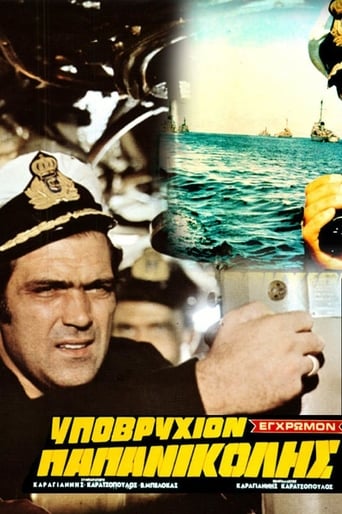
October 28, 1940. Along with the Italian army's attack on the Greek-Albanian border, Greece comes under fire from the Italian air force. The submarine Papanikolis, commanded by Captain Milto Iatridis and First Officer Vasilis Aslanoglou, is ordered to patrol the Gulf of Patras. Following the army's victories, the war council decides that it is time for the navy to enter the war and orders the submarine Papanikolis to patrol the Strait of Otranto. There, the crew captures the crew of an Italian ship and their engineer reveals the minefields of the Adriatic. Thus, the Papanikolis begins its mission. After completing its mission, it returns to its base, where it is honored.
Activate your FREE Account!
You must create an account to continue watching