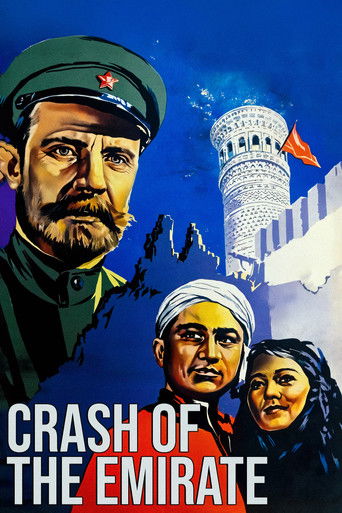
1920. Western countries are trying to use the Bukhara khanate — a former protectorate of tsarist Russia — to fight the Soviet regime. Arrived in Tashkent by M. V. Frunze and V. V. Kuibyshev to organize the masses to fight counter-revolutionaries and agents of foreign intelligence services.
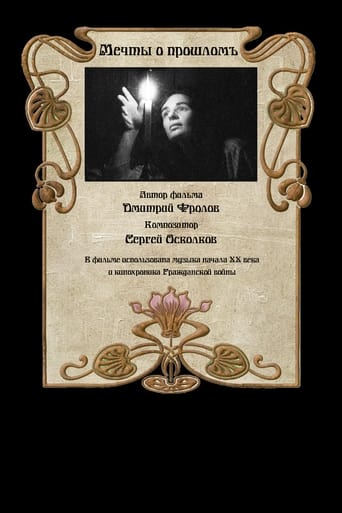
A film about peace, love and war. Dedicated to the 100th anniversary of the end of the Civil War in Russia. The film takes place at the end of the summer of 1917, when Russia and the whole world were at a crossroads between two eras. None of the people could even imagine how much his life would change in the very near future. In a strange way, the atmosphere of the film echoes our current reality and what is happening in Russia today. According to the form of visualization, the film belongs to experimental mockumentary cinema. To give greater authenticity to what is happening on the screen, the shooting was carried out on black-and-white negatives of 16 and 35 mm, hand-operated cameras were used and the material was developed in manual spiral tanks. The documentary chronicle of the Kolchak army of 1919 and the White army in the Far East of 1922 is embedded in the finale of the film.
A doctor is called to the home of a young man who wants to enlist in the Army.
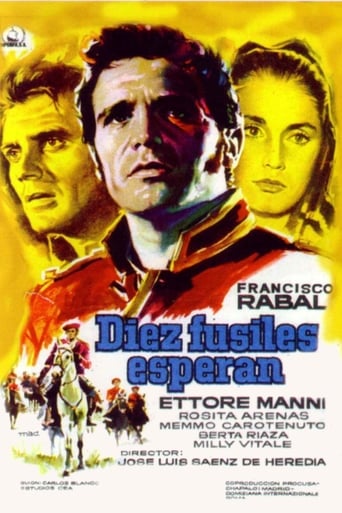
During the first Carlist war in the 1830s in Spain a lieutenant falls into the enemy's hands and is arrested. When condemned, he claims he only wanted to see his newborn baby.
Made refugees by the war in Ukraine, Olga and her granddaughter Milana travel to a summer camp in the Austrian Alps to test the limits of their own bravery, and to strengthen their growing bond.
Lieutenant Commander Colton, U.S.N., is in love with Caroline Austen, daughter of a prominent political power in Washington. Colton has a rival in James Archer, a journalist of prominence, unscrupulous and secretly in league with the Ruanian Ambassador, who is endeavoring to obtain for his country inside information as to the United States naval resources.
The main character is Anna, an outstanding pediatrician. She survived the harsh years of war in a concentration camp and cannot accept the behavior of her daughter Natalia, who uses her connections and cares only about material goods. Anna is reminded of 1939, when Piotr, who had been missing for forty-five years, arrives in Poland. Together, they visit places that are important to them: Auschwitz, Sachsenhausen, and Ravensbruck.
A story about the key events of the Wielkopolska Uprising - a dramatic arrival of Ignacy Jan Paderewski in Poznań, and the people who prepared the uprising, fought in it and won.
A history of Argentina's last military dictatorship (1976-1983). After "La Republica Perdida" was made, which covered 1930 to 1976, there was an important part of Argentina's history yet to be told, which was too recent to be covered by the first documentary. The first movie was made at the end of the last dictatorship. This second documentary covers this last dictatorship from 1976 to 1983.
During the final years of the World War II, Finnish sergeant Myllykoski and his fellow soldiers are forced to join the notorious Waffen-SS on a mission to find a mythical medieval chalice in the Soviet Union.
A speechless war poem set in a remote village. The farmers struck by war turn into fighters.
A group of Polish communists in Paris arrives in Poland to fight against the Nazis.
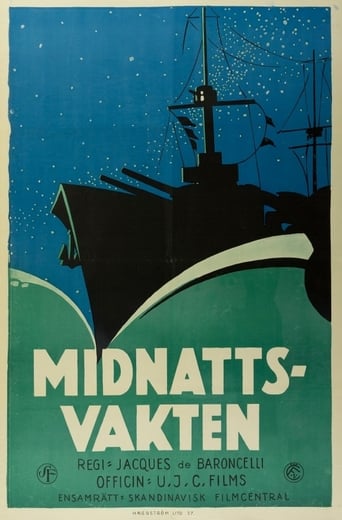
When the commander of a cruiser ,which sank in a confrontation,is tried for negligence, will the wife speak up in his defense? Unknown to him, she was trapped in the cabin below with her former lover, a subordinate officer.
Major Briggs, one stiff upper-lipped Brit, receives a hand-to-head treatment in a North African bar. Impressed, he recruits the most skilled American specialists to help him blow up Rommel's most treasured ammo depot. Perilous desert journey awaits them, especially given an inevitable rendezvous with one immoral priest, a German nurse right beside him.
This British espionage thriller stars Terence Stamp as David Audley, former Oxford professor turned intelligence agent.
A documentary focusing on multiple nurses who served during the Vietnam War.
The young Alexandru Bota, a former Romanian volunteer in Garibaldi's army, joins the secret organization "Order of the Rose" which initiates an action meant to lead to the liberation of the peoples from the Habsburg tyranny. One of the leaders of the order violates the agreement established with Prince Cuza and plots the assassination of Prime Minister Barbu Catargiu, in order to initiate an outbreak of war on Romanian territory.
An unusual Marathi war movie which mobilises and updates a historical/regional chauvinism associated with 17th-C. Maratha emperor Shivaji. Major Subhanrao Malusare, a direct descendant of Shivaji’s legendary lieutenant Tanaji Malusare, continues a proud family tradition by winning the Victoria Cross as an Allied officer fighting against Italian fascists in WW2. When he dies, his wife Savitri (Uma) vows that their son will never join the army. However, during the India-China conflict (1962), when her son’s friend is killed, she enjoins her son to fight for the nation even though the boy’s death would mean the end of the ancient clan. The film updated the rousing sentimentalism associated with Shivaji historicals into the present via songs such as He bharatiyano aika balidan katha veeranchi.
Activate your FREE Account!
You must create an account to continue watching